Showing posts with label Photosophical. Show all posts

Do you hang what you shoot?

Alpine sunset as seen from the Rigi.

This blog post is related to the one about "boring landscapes" that I have recently written and a somewhat similar idea was also elaborated in a podcast by Brooks Jensen. Although I like and appreciate beautiful landscapes and the outdoors, these subjects are not the ones that I seek the most as a photographer. I find it more challenging and satisfactory to search for hidden details that are only discovered by the careful observer than documenting a beautiful landscape. Interestingly though, if I had to choose a preferred photograph, or select one to be printed in a large size and hung in our apartment, I would choose a landscape composition! Strange, isn't it? Maybe a contradiction even.

Thinking about this topic made me realise that the two types of subjects refer to two completely different disciplines. For me, landscape photography is mainly about the location and moment in time where and when it is conducted. It is about an experience in the outdoors and photography is (only) a documentation of such adventures. It aims to capture the grandeur of a scene as closely (often better) as one remembers it, but the photography does not alter the experience (it may even prevent us from fully appreciating a scene). What does alter the experience is the adventure: the hiking, camping or whatever activity that was necessary to get to the spot where a particular photograph was composed. In my opinion, landscape photographs are about adventures, small or large, and such compositions exclaim "I have been there in this extraordinary moment and it looked like this!"

In contrast, the photography of hidden details is like a riddle that needs a creative solution. It is about finding a composition, at any time and in any place, that will captivate the viewer. Hidden detail photography is a quest for interesting compositions, also in places where I would never seek an adventure. It requires and practices a positive and inquisitive attitude and thus transforms my experience of the environment: it changes how and what I see, my appreciation for a particular place, and even my attitude at my life in general. Being and becoming more conscious of small details that I like makes me more appreciative overall. Most hidden detail photographs ask "Did you notice that?" and encourage me, and hopefully some of you, to experience our everyday environment more consciously.

But let's come back to the question stated in the title of this text. Apparently, often I am not shooting what I would rather hang on my walls. I long for adventures in the outdoors, for majestic views over natural wonders. Photographs that address this longing are the ones that I prefer to be hung as posters on my walls. On the other hand, as a creative activity and a complement to work and family, the photography of hidden details is incredibly satisfying and fulfilling and enriches my life.

I think this is enough about this topic for the moment. Let me know if you have other thoughts, opinions or additions. This post started with a photograph that I may enlarge and hang on a wall, and it ends with a composition that I am proud of having found.

Zig-zag reflection, Forum Chriesbach (EAWAG), Zurich.

2015/12/26 by Unknown
Categories: , , , | Leave a comment

Pixel temptation

Photo & Video Sharing by SmugMug A photograph from autumn 2014 - a colorful leaf in a nearby stream. How many pixels does this photograph need?

I have to admit that from time to time I consider buying (or even actually buy) equipment that I do not really need at all, just because of its availability. For example, I am tempted by pixels despite my knowledge that even my Lumix GH1 has enough of them. This is the case because I sometimes suffer from the nagging thought that a photograph that I really like could have been better had it been captured with a higher resolution. A clear sign of pixel regret.

Our recent holiday was a healing experience for this condition that sometimes overcomes me. I am embarrassed to admit that during our five week holiday I have destroyed more of my photography equipment than in all my life before (one camera, two lenses is the balance). With my high-resolution camera down, I had only my old but hard-wearing Lumix GH1 to use; also in situations where I would have preferred to use the "good camera", if it had been working. Although I heard "should have" and "could have" mumblings in my mind, the results are, in my opinion, perfectly fine. Just have a look at the January 2015 print!

This is of course no surprise at all. It is virtually impossible to recognize what camera was used to create a particular photograph, irrespective of whether it was a small compact camera, a systems camera, or even a medium or large format camera (as long as the print is not too large). If you want to try, head over to the New Zealand gallery and identify the photographs taken with the Lumix FT3, the GH1, or the Sony A7r.

The intention of this post is to remind myself to better resist pixel temptation and other temptations of the photography industry. All my equipment preoccupations mainly distract and keep me from using my equipment to create photographs that I am satisfied with. Moderation is the motto.

2015/02/16 by Unknown
Categories: , , | Leave a comment

Objective pointlessness - subjective meaning

Photo & Video Sharing by SmugMug 
Reflected light reflection in Zurich Oerlikon; a photograph from my light & shadow collection. I really enjoy searching, seeing and photographing new subjects and overlooked details of beauty in deserts of concrete and asphalt (despite the fact that I much prefer nature). In this photograph, taken at the skyscrapers at Hagenholzstrasse (already shown in a very different photograph a long time ago), I like how the beam of reflected light in the foreground and its reflection lead straight into the frame and add depth to the composition - ironically in a direction where there was no depth at all; I was just a step away from the glass window.

It has been a (long) while since I have written about my philosophical thoughts; not because I have stopped thinking, but rather because I have hesitated if to write at all and which thoughts to share. Often, I have the impression that too much is being written by too many people and that all I can add are platitudes.

Today's truism is following me since a long time: The nagging awareness that there is no higher, objective meaning of my life, of life in general, or of anything at all. In moments when I become aware of this objective pointlessness, a feeling of vast, all-encompassing emptiness and discouragement may overcome me. Most attempts to fill this void with meaning, for example by objective reasoning, are doomed. However, the antidote to the venomous influence of objectivity is a subjective, inward look at life.

Meaning is by definition subjective; inherently linked to the person, the subject, who seeks meaning. The meaning of my life are thus my experiences and the lasting, happy and appreciative memories they create in my brain. Such a subjective view is also comforting for less fundamental questions than the one about the meaning of life. I often pondered decisions at length because I sought the "right" decision, not realizing that it was not a question about right or wrong, but rather about personal preference.

Please do not misinterpret and conclude that all I advocate is subjectivity. This is not at all my point; after all, I am a scientist! All I am saying is that life without meaning is really quite miserable. It is my objective conclusion that the only way life can have any meaning is with a good shot of subjectivity. I think the label "subjective objectivity" would be a funny, but fitting concoction for this point of view.

It seems to me that photography may actually exemplify the quest for meaning and the importance of objectivity and subjectivity. I believe that many people photograph so that they get an object - the photograph - of their experiences. It is an attempt to attach an objective meaning to their experiences by collecting objects (pictures). On the other hand, the activity of searching, seeing, creating and capturing a photograph may be incredibly fulfilling and rewarding to photographers - to photograph, not the photograph itself, gives (subjective) meaning to their lives.

I wish yo

2014/09/14 by Unknown
Categories: , , , , | Leave a comment

Art socks

Once upon a time, Art was overcome by a feeling of dissatisfaction and emptiness. He was longing for more - more recognition, more fame, more success. Art had been knitting socks since a couple of years and felt that he had to bring his knitting to a new level. He has perfected his craft, always upgraded to the newest knitting needles, only used archival wool, and even invested in noble argon atmosphere containers to preserve his socks in pristine condition for centuries. He stayed abreast of the newest developments in the sock knitting business and created a large following with his blog and by interacting with his many friends on me2, sockbook and SockR. Nevertheless, his sales stalled. 

To promote his knitting, Art had started offering themed knitting workshops, took on book projects, and did commissioned sock knits here and there. However, with all these efforts, he had less and less time to develop his knitting vision, let alone to actually knit, and he felt just as one anonymous knitter in the big wide ocean of knitting enthusiasts (a feeling that became particularly strong after his ever rarer visits to the SockR website). He clearly had to find new ways to found his righteous claim for knitting greatness. After all, he had many thousand me2-friends and subscribers on his blog, while some of those silent wannabe sock knitters were not even on sockbook!

Art's socks were much more than socks - he thought. He clearly had a unique sock vision, incorporated profound feelings and emotions in the yarn, and embedded deep and universal meaning and insight into his sock compositions. His socks were not merely socks, they were works of art - thus, "art socks" was born! From that moment on, Art was not just a knitter anymore, he was a knitting artist (for brevity and crispness, "knitting" was soon sacrificed - he really was an artist now). The success was beyond anything Art could have imagined. Suddenly the true value of his socks was recognized, they sold like hot cakes, became sought after collector's items, and even found their way into museums and galleries.

The success of Art's art socks did not remain unnoticed for long. The community was amazed and admired Art for his ability to elevate sock knitting to a whole new level (albeit some missed the good old times and lamented the decline of traditional sock knitting values). Soon, art socks sprouted like mushrooms, because almost every sock knitter saw transcendental value in his very own socks. Art himself was now a celebrity and nurtured his cult status. He was busily jetting the world, endorsing a new model of knitting needles here, naming a new yarn color there, launching fine art sock series, and distributing personalized designer art socks to celebrities all over the world. The knitting was now mostly done by his assistants, but he still insisted on casting off the last stitch of all his original signature fine art socks - a task quickly completed on a stop-over and while on the move.

This is how the craft of sock knitting became an art and as long as there is a public there will always be art. However, the public acclaim may not correlate with the content or quality of a piece of work, but rather with the value an artist manages to attach to whatever she creates. For, it is not the craftsmanship that is the art. Art is the creation of something artificial - in many cases an artificial value.  This is neither good nor bad, but please remember: All the fuss about art is just a distraction. After all it is only about knitting socks and it is perfectly fine to just knit socks!

Val di Comologno, Tessin, Switzerland A photograph (not a work of art) of Val di Comologno, Ticino, Switzerland.

2014/01/27 by Unknown
Categories: , | Leave a comment

The fairy tale of the egg laying wooly milk pig

An egg laying wooly milk pig is the german equivalent of a jack of all trades device. It is the fabulous creature that does everything as perfectly as anyone could ever wish. But, as I am sure (almost) everybody knows, such mythical creatures do not exist. Only Camera and Lens Review (do you remember them?) do not seem to be aware of this important little fact. Camera Review thinks that the jack of all trades device does exist and for example criticizes cows that fail to lay eggs or give bad wool. Even more disadvantageous is the blind loyalty to Camera Review by the majority of customers. Why on earth do people care about eggs if all they want is a glass of milk?

Unfortunately, the farming industry has submitted to the dictatorship of Camera Review by and large and really tries to create the impossible. Of course, all they come up with are unsatisfactory compromises whose eggs are ridiculous in comparison to a proper chicken (or even duck) egg, whose wool is only a shabby imitation of a sheep's product, or whose milk not even remotely resembles the richness of real milk. But a tiny egg, a shabby fur or watery milk is better than nothing and prevents criticism for a major omission, which seems to be the most feared form of critique of all. We may actually already have the milk cow that lays perfect eggs, but we do not realize it because Camera Review thinks it should definitely also have a sheepskin and provide us with a juicy ham.

I am of course not writing about genetically modified livestock, but about cameras. A camera with more functions is not automatically a better camera. Take an inbuilt flash as an example. If a manufacturer omits this useless feature, the camera will be criticized for this lack, receive less points in questionable camera comparisons, and be less sold (I assume this is the reasoning of camera manufacturers). Of course, if a flash is included it will be criticized for being weak, small, of short reach, at the wrong location etc. For most people it would be much better if their camera did not have a flash included, not only to prevent flashing while they photograph the Golden Gate Bridge from 300 m afar during daytime, but also because their cameras would have less buttons, simpler operation, longer battery life and a smaller housing. There are many other camera functions that are included for the very same reasons - only to provide as little contact surface for Camera Review as possible, not because they are really needed. I would really wish there were more manufacturers that design cameras with more courage to omit (unneeded) features! Omitting a function may be a quality, not a lack!

P.S. Before publishing this text, but after I had started writing it, a wooly pig and an egg laying cow were announced: The Sony A7 and A7r. Note: Neither of the two cameras has an inbuilt flash!

Photo & Video Sharing by SmugMug  
A light & shadow composition on a facade in Hong Kong - also taken with a tiny point-and-shoot camera.

2013/10/16 by Unknown
Categories: , | Leave a comment

Holiday photography: Crab shells on the beach

Photo & Video Sharing by SmugMug Crab shell lips, Olympic National Park.

I have mentioned the photographer Scott Cahill Rude, whom we have discovered on our recent vacation. Of course, we have also seen plenty of natural and man-made beauty that I sometimes tried to capture in photographs. I would like to show you some of these compositions in this and in upcoming blog posts.
Pursuing photography while traveling with your family is on one hand very easy, but on the other hand also much more challenging than you may first realize. The large majority of the photographs are of course rather documentary and private. We look at these pictures together, include them in our family year or holiday books and use them as time machines to bring us back to our five weeks of camping, hiking and enjoying the outdoors (unfortunately the photographs have so far only brought back memories - I am still waiting to be physically beamed back in time). In summary: these captures are not meant to be shared with “everybody” and I rather refer to them as pictures than as photographs (even though some of the portraits are very nice). Photographs, on the other hand, are deliberate and conscious compositions that I create according to my vision and which I consider worth sharing here.

Photo & Video Sharing by SmugMug Crab shells and sand pattern.

One of the difficulties with family holiday photography is of course that you spend only a limited amount of time at a particular location. Often you will not be at the right place at the right time (which is the reason why nearby photography is fulfilling and very satisfactory). A possible solution is not to photograph famous landmarks, sunsets, or sunrises, but rather to pursue themes that depend less on the time of day, or a particular weather condition, but may be discovered everywhere. For example, during our holiday I did not even think about a “real” photograph of any of the huge Sequoias, the Yosemite valley or the Golden Gate bridge (to name just three) - a picture is clearly enough at these places. Instead, I had planned to delve into flower photography (but hardly ever felt inspired to do so during our trip), looked out for new carcolor compositions, discovered exciting facades and buildings, took many new photographs of water (an ongoing project that I will show sometimes later), and created a collection of beach photographs - a type of photography subject completely lacking in Switzerland (unfortunately). The beach photographs shown here show the remains  (exuviae) of crabs, which we found in huge masses on Kalaloch beach in Olympic National Park. Piles of crab remains are nothing to be worried about: Similar to animals such as snakes or lizards, crabs have to molt as they grow. Since this can happen quite synchronously, some beaches may become littered with crab shells and parts at certain times of the year. It seems that we have been lucky (as the last photograph indicates - it is only added for illustrative purposes and not part of the natural beauty collection). The species of crab is most likely a Dungeness crab (Metacarcinus magister), but I am not a specialist and therefore not entirely sure.

Photo & Video Sharing by SmugMug 1 Right-side up, 4 upside down.

I have been enticed to take these crab carapace compositions because of an abstract theme that I have been working on for a long time already (I refer to it as "outlier" - the photograph above is an example). While looking for ever new crab carapace arrangements, I have found new angles and compositions that did not fit the original idea any more and I ended up with a small collection of, as I think (but less so my wife), beautiful crab shell photographs. I particularly like the first example because it is a rather unexpected view of a crab carapace, because the light shines so beautifully through the shell, because of the interplay between focus and out of focus, and because the shape of the shell looks like a mouth with lips (to me). I would also like to emphasize that the carapaces were not touched let alone arranged in any way. The photographs show the crab remains as I found them washed upon the beach and after the next wave or high tide everything was different again. The photographs are stored under in my natural beauty section within the nature detail gallery.

Photo & Video Sharing by SmugMug Crab remains on Kalaloch beach, Olympic National Park.

2013/09/20 by Unknown
Categories: , , , | Leave a comment

Just go and overcome your laziness!

Since you have decided, like Hamlet, "to be" instead of "not to be" (otherwise you would certainly not be reading this), the next important question is "to do or not to do?" It is much easier to just exist and go with the flow (i.e., "not to do") than to overcome one's laziness and to do something. For example, nature photographers or mountaineers have to bring up the energy to leave their warm and comfy bed (or sleeping bag) in the middle of the night, when it is dark and cold outside. If the weather is bad or uncertain, the activation energy required to overcome one's comfort may seem almost unsurmountable.
Photo & Video Sharing by SmugMug
Snow, fog and rocks in the "Kreuzberge" (Chrüzberg). I was visualizing a scene like this all along our hike on the ridge and in the fog. When we arrived at the spot with this view, I only managed to take one single photograph before the fog swallowed the whole scene.

For a family of five, the number of "free" weekends is very limited. Last weekend was such a rare occasion and therefore we had planned a trip to the mountain Hoher Kasten (reached by cable car from Brülisau). The summit of Hoher Kasten is the starting point for a beautiful panorama hike that brings you in 3-4 hours of ups and downs, and after many breathtaking views down to the river Rhine, Germany and the Austrian alps, to the mountain hotel Bollenwees. 

Unfortunately, the weather was, like so many times this year, not perfect. We hesitated whether to leave or to stay at home and not everybody was looking forward to the prospect of hiking in the rain. When we arrived in Brülisau, rain was pouring down and no mountain was visible. However, after a picnic in the car it had cleared up and we decided to take a chance and boarded the cabin of the cable car. 

Photo & Video Sharing by SmugMug
For a short moment, the clouds and fog cleared and revealed the rocky summit of the "Altmann" - and a beam of light also passed through the clouds to "complete" this photograph.

Our gondola soon disappeared in a dense cloud and all the way along our hike on the ridge we could only imagine, but not actually see, the beautiful view. We only caught short glimpses of the breathtaking view when holes in the dense soup of fog formed. However, the lush vegetation and bright alpine flowers, covered with rain drops, were compensating for the lack of a view and accompanied us all along the way. Also due to the inhospitable weather conditions, less hikers were en route and we obtained a room at the Bollenwees on short notice (often this guesthouse is booked weeks in advance). The quietness was probably also the reason, why two alpine ibex, still in their winter fur, grazed next to the hiking path (two hikers in front of us alerted us of their presence).

Photo & Video Sharing by SmugMug
Two alpine ibex, still in their winter fur, in the Alpstein massif. The two animals were busy devouring the fresh leaves and hardly took notice of us, even though we were only about 10 meters away.

There are many pictures stored in my brain that I will keep as good memories of this trip and the photographs above show three actual photographs that I managed to take as well. I even think that conditions like this, with quickly changing weather conditions, moving clouds and appearing and disappearing views and beams of sunlight, can render the experience of such a trip much more memorable and "special". My conclusion and advice is thus to always try everything to overcome one's laziness and to do "something" irrespective of the weather - it is (almost) always worth it!

2013/06/30 by Unknown
Categories: , , , | Leave a comment

Nearby photo subjects

Photo & Video Sharing by SmugMug
Leutschenbach school at dawn. The Leutschenbach School is a minergie building in Zurich that was designed by the architect Christian Kerez and finished in 2009. Most walls and the facade of this fascinating construction are transparent or semi-transparent and the entire top floor is a gymnastic hall.

Sometimes, I am gripped by wanderlust and long for remote places and adventures far away from my everyday routine. Such feelings overcome me particularly in moments when I think of pristine nature and remote places. However, this longing for wilderness in foreign countries has somewhat abated in recent years. The turning point was when I started to photograph where I live instead of only on occasional trips to the mountains or on holiday.

Although I have always been attracted by geometric patterns and man-made beauty, for a long time I have not considered it worthwhile photographing such subjects. An early example of a man-made beauty photograph that I still like is the school building shown above. On a Saturday morning I had seen from the train that several people with huge tripods and view cameras were photographing it. Out of interest, I passed by in the evening and there was still one photographer left. It was the weekend before the building was being opened and he took photographs with different floors and sections of the building lit up. I was even offered to have a look at the building inside and climbed all the way to the top. What a nice building - the top floor is the gym and the glass walls permit terrific and far views over the north of Zurich. For the first time ever I regretted not being a pupil anymore! 

Since then, I have returned to this beautiful school and to other buildings in my neighborhood regularly and I have started to take more and more photographs. As soon as I started to regularly photograph in my man-made habitat, I became aware of things I had never observed before, which encouraged me to photograph more, which made me look even more carefully and consciously, and so on. I had entered an upward spiral of positivity! This blog post is the starting point for a new "nearby" series and gallery highlighting the fruits of this spiraling.

It is my utmost concern to emphasize and to try convincing you that moderation can make you a better photographer (and a happier human being). Moderation not only concerns equipment purchases, but may also - and this is the topic here - apply to traveling to distant and famous places. I will try to convince you that interesting subjects can be found nearby your home and that the closeness and the intimate knowledge of your environment will open your eyes and thereby reveal subjects that an occasional visitor would never notice.

Like the photograph above, all compositions that will be shown here were captured nearby where I live, in Zurich, within walk, bike or public transport distance of my home. Since I live in the northern part of the city of Zurich, which is called Oerlikon, the large majority of the photographs are from this area. The photographs will reflect the different themes that I have been or am pursuing - lights and shadows, reflections, facades, or other intimate details of man-made beauty (a few "Zurich-photos" have already been featured). I hope that you will find the mixture interesting and that one or the other photograph may encourage you to seek subjects that are close by. I am sure that it is worth it, because you will take your best photographs in the environment that you know best!

2013/06/26 by Unknown
Categories: , , , , | Leave a comment

Photographs not taken

If I look at this black rectangle I see a perfect moment that is imprinted in my mind. The main subject is recorded in every detail and stands out from its surrounding like no real photograph could ever record. This black shape is thus a container that is filled with my memories and I hope that all of you have similar pictures that miraculously appear when you look at this frame.

We are buried in an avalanche of photographs. All kinds of digital cameras, mobile phones and now even glasses record almost every aspect of our lives and enable us to take more photographs than ever (as previously mentioned). In the light of such an over-abundance, it seems appropriate to shine a light on the opposite: the photographs not taken. I have meant to write about photographs that were not taken for a long time. Finally, I feel inspired to do so - not only, but also - because I have just discovered that there is even a nice little book on the stories behind photographs that were not taken (The Photographs Not Taken by Will Steacy).

The reasons for not taking a photograph can be manifold. You may primarily think of technical reasons - a forgotten or malfunctioning camera, for example, or of a subject that vanished before you managed to pull out your camera. In the book The Photographs Not Taken, ethical quarrels are also cited repeatedly as the reason why the camera was put aside or not picked up. Finally, you may consciously choose not to photograph in order to experience an event or moment more deeply, or because the subject at hand can simply not be satisfactorily captured in a photograph.

Photographers may regret their missed photographs. However, I disagree with the view that "these moments passed into oblivion" (as the book review in Lens suggests). Our brain is an incredibly powerful recording device. It focuses on those aspects that attract us and blends out disturbing elements without any photoshopping at all. A moment or glimpse of something beautiful, a flash, a sparkling light, or a look can be imprinted and fixed in our brains for many years or as long as we live.  

Revisiting these recordings in the personal image gallery of my brain makes me painfully aware of the transience and rareness of such moments. Sometimes, I may therefore look at these images longingly and more often than I would wish. However, these moments have been kept and are experienced much more deeply; not despite, but BECAUSE they have not been recorded by a camera. 

2013/06/10 by Unknown
Categories: | 1 comment

Choosy

The following thoughts were initiated by a recent experience at work where somebody had difficulties choosing what to present and what to leave out. Although this situation had nothing to do with photographs, it is just as relevant in photography and in many other aspects of our daily lives as well. It is important to choose, to be choosy and to leave out.

Have you ever seen a man wearing ten precious designer watches on each arm? Or did you ever have the chance to admire a women's ear with all of her most sparkling and beautiful earrings on display? Or did you ever watch a movie with seven different endings and 13 main characters? Most likely not.

Besides the impracticability of wearing 20 watches, beauty only exists in isolation. It is impossible to appreciate the beauty of a single piece of jewelry in a treasure chamber or an interesting movie plot amongst all possible parallel universes. This blog post is of course not about watches, earrings or movies, but about photography. 

On one hand, you cannot use several lenses or cameras at once - a reason why I am an advocate of moderation when it comes to equipment. On the other hand, you cannot photograph multiple subjects simultaneously (you can of course, but in my opinion your photograph will be difficult to appreciate). Finally, you also have to be choosy when it comes to selecting and editing your photographs.

Before photographing a scene, decide what you want to capture. For a wildlife or wildflower photographer, the gist is obvious, but subjects worth recording on a memory card may also be a particular quality of light, a color, a structure or pattern. In either case, your goal as a photographer should be to emphasize and isolate the core of your photograph. Choose what you want to photograph, isolate the main subject and emphasize the essence of your capture by arranging the elements of your composition. You have to choose and to be choosy!

Photo & Video Sharing by SmugMug
"M" - A simple composition from the Drapes & blinds gallery. I have several versions of this photograph - this is the  most "intimate" and my preferred composition. Obviously, I have been fascinated by the waving pattern of the shadows that the morning light paints on this curtain. 

2013/05/23 by Unknown
Categories: , , , | Leave a comment

Daily memory card backups without a computer

Photo & Video Sharing by SmugMug Mountain shadow in Krimml, Austria. A photograph recorded on slide film in "pre-memory card times" and when daily backups were impossible.

Capitalism and consumerism sometimes bring to light extraordinary products of questionable utility. Just recently, I have come across an electronic fork that records how much and how fast you eat and warns you in case of hasty devouring and gluttony (if you really need to see it, THIS is the link). In contrast, a device that secures and protects the images of millions of photographers by creating backups independently of a computer, a memory card copying machine, does not seem to exist at all!

Consider the following: In the year 2012, 10% of all photographs that have ever been taken in the history of photography were recorded (for example, according to TIME). I am certain that only a small percentage of these digital images were backed-up and therefore an enormous number of photographs are certainly lost every day due to memory card malfunctions, theft, loss or other accidents. On a global scale, such losses are completely insignificant, but for the individual photographer it may be devastating and saddening. I still think with melancholy of the photographs of an entire roll of film that was "lost in development" many years ago!

At the moment, I am searching for a reliable backup solution that is independent of a computer. Usually, I take rather few photographs and could easily suffice with two or three memory cards for an entire trip. However, I feel uncomfortable having all photographs on only one card all the time. I would like to regularly backup the photographs to a second location (not an online storage service). The perfect solution would be a small device, similar to a card reader, which creates backups on a second memory card or a USB flash drive. Unfortunately, such a memory card copying machine does not seem to exist.

The solution that I have now come up with is rather simple and straightforward. It requires the following three steps for each memory card:

  1. The memory card is backed-up daily to a tablet (Motorola XOOM, rooted, but I do not know if rooting is necessary for all tablets).
  2. From the Xoom backup, two additional backups on two different USB flash drives are made.
  3. As soon as the memory card is full, the backup on the tablet is deleted and the card as well as the two USB memory sticks are stored at three different locations. 

For this approach all you need is a tablet with USB OTG support (which I will take with me most of the time anyway), an USB OTG cable, a card reader and the USB flash drives. The backups are created with the FolderSync App (other apps may also work, but I have decided on FolderSync and it works perfectly) and the whole procedure worked flawlessly on a recent short trip. I am hopeful that this will be acceptable and reliable on longer trips as well.

Do you have better solutions? Or has somebody found a memory card copying machine? 

2013/05/11 by Unknown
Categories: , , | Leave a comment

The "saving money by spending it" fairy tale

Photo & Video Sharing by SmugMug
An impressionistic ripple effect tree reflection in the river Areuse, Switzerland, 2012.

Once upon a time, children saved money in a piggy bank and grand parents had an old sock underneath their mattress that held their savings. As time went by, saving became more sophisticated and a profitable business. Savings books and later shares replaced the pottery pig or the woolen sock. I believe we have now reached the most evolved method of saving: By spending money! Consumerism advertisement tries to convince you that paying less than the regular price equals saving money. This is a very smart concept and a fallacy that many succumb to. However, nobody has ever saved money by spending it! 

I have just visited three major photography retailer websites (Adorama, Amazon, and B&H). Two of these (Amazon and B&H) inform me with a dedicated title instant saving or you save that I save for example 80 or 200 USD and only have to pay 300 or 3500 USD, respectively. In contrast, Adorama seems to pursue a more correct and commendable strategy: They only announce a special price and a regular price, but do not promise any savings. Does this make the Adorama deals less attractive? I hope not - the opposite should be the case!

Save is one of the most mis-used words in advertisement and at the core of the consumerism brainwashing machinery. What I find particularly shocking is that savings seem to replace criteria of quality and actual need. Often, cameras (and of course also other products) are advertised solely with the savings that their purchase promises. The meaning behind this advertisement language is: "We have absolutely no argument why you should buy our old and soon to be replaced camera and therefore we make you believe to save money by buying it so that we can get rid of our stocks." I hope that you are aware of this meaning and do not fall victim to such promises of great savings.

I do not at all suggest to refrain from buying cameras, lenses or any other tool or item that you really want to use. I would even help you decide what photography equipment is most useful for you, if you want. If you can afford, buy all the things that you really want to use and rather decide based on the quality of the product than its price or novelty. However, do not believe that you will save money by buying something, because you will not. Similar problems are actually commonplace in other areas as well. For example, you neither loose weight by eating nor do you protect the environment by buying a new car.

2013/04/21 by Unknown
Categories: , , | Leave a comment

10 reasons why you do not need a new camera

I do not support the photography industry very much, because I consume far too little and rather advocate moderation. I am convinced that limiting myself is only positive. As a consequence, I have become really good at NOT buying stuff and I would be glad to help you discover and develop this skill as well. If you need arguments to prevent you from unnecessary purchases or to help preventing compulsive camera buying syndrome (CCBS), please either use the contact form or fill out the the questionary that I have prepared. 

10 reasons why you do not need to buy a new camera:
  1. Picasso used cheap paint (original reference here) for his paintings - why would you need an expensive new camera? 
  2. Contemplating new equipment is just a compensation for not photographing often enough. The only successful strategy to improve your skills as a photographer is to photograph more - not to buy or review cameras. 
  3. No photographer has ever taken great photographs with different cameras and lenses at the same time. All you need is one camera with one lens that you really know how to use.
  4. Cameras do not compose and take great photographs all by themselves. YOU have to photograph; the camera - any camera - is just recording photographs for you.*
  5. If you own a reasonably new camera with a lens (probably bought sometimes during the last five years) you have everything that is necessary to take great photographs.
  6. If you suffer from a pixel inferiority complex and therefore intend to buy a higher resolution camera, remember that you would likely also need a new computer, more hard drives for backups and more time for editing.
  7. Some of the money spent on a new camera could be invested much more wisely: buy an accessory that really fosters your creativity and which allows you to do new things.
  8. With a new camera, your photographs will not become better - rather the opposite. You can take the best photographs with the camera that you know best - this is unlikely to be a new camera.
  9. Comparing camera and lens specifications and purchasing new equipment takes a lot of time and energy, which you cannot invest in taking better photographs. 
  10. You actually own already too many cameras and most of the purchases are for similar things that you already own - before buying another one sell all of the ones that you did not use within the last year.
All these arguments burn down to one simple conclusion: Most likely you do NOT NEED a new camera. I am also tempted by new cameras regularly and sometimes I do of course buy new equipment. However, self-sufficiency, functionality and quality, as opposed to quantity, make me much more happy and content. Therefore, and despite the fact that I am interested in the technological side of photography, I buy only little and often rather small things that help me use what I already have, because I know that:

The less things I own, the higher the value of each item.
The less tools I own the better I will know how to use them.
The less I own the less I will have to carry around.

Photo & Video Sharing by SmugMug
The two towers of the Hotel NH Fiera in Rho/Milan, Italy. The buildings are not straight and they are rather close to each other. I particularly like how the sunlight facade on the right building disappears in the white sky. Only the black windos are visible and seem to float in between the two buildings. 

*I know that there are some cameras that automatically and non-randomly take photographs. However, I would deny these machines the capability to compose.

2013/03/03 by Unknown
Categories: , | 2 comments

1000 $ is enough!

Several times I have expressed reservations about the review-preview-rumor culture and consumerism in photography (most recently in a fairy tale), but I do of course not completely ignore the technological side of photography. My main criticism is that most reviews are pseudo-objective, theoretical analyses of specifications or performances that have little practical relevance. Buying and using a camera is not objective, but a very subjective action and decision.

Although it has been stated over and over it must be repeated: the best camera is the one that you have with you most often and that you use most regularly. Therefore, it may be relevant how much (theoretical) image quality you obtain with each gram of camera that you carry around. Furthermore, I think it is important to question how much image quality you obtain for the money you spend on a camera. I have been wondering if the existing camera ratings, in particular the DxOmark overall scores, can be used to answer these questions. Here, I show you two graphs that I think reveal interesting aspects about camera performances, weight and prices.

1. IQPW & IQPM
I have arbitrarily selected 31 current cameras that were tested by DxOmark and for which I found current prices on www.toppreise.ch (for discontinued cameras I estimated the price of a used camera). Then, I calculated the IQPW (DxOmark overall score divided by the camera weight) and the IQPM (DxOmark overall score divided by the camera price). The IQPW tells you how much DxOmark score you receive for each gram of camera that you are carrying around and IQPM indicates how much DxOmark score each swiss franc (or whatever currency) buys you. The results of this analysis are shown below (the cameras have been sorted based on IQPW in descending order).
Image quality per camera weight (IQPW) and per money (IQPM) for a few mirrorless, DSLR and point-and shoot cameras. Image quality is defined by the DxOmark overall score and the current lowest price (in Swiss francs) was looked up at www.toppreise.ch. 

Three noteworthy observations:
  1. With the Sony DSC-RX100 you obtain 4.6-times more DxOmark score for each gram than with the Canon EOS 1Dx (and the Sony already has a lens, while the Canon is only the body).
  2. You obtain twice as much DxOmark score for each Swiss franc spent on the Nikon D3100 as compared to the Canon EOS 1Dx.
  3. All compact cameras (compact system and point-and-shoot cameras, area shaded in blue) have a better IQPW than conventional DSLRs (area shaded in red).

2. DxOmark score vs. price and weight
Next, I have selected all cameras with DxO mark scores, wrote down the prices (in US dollars) that are listed by DxOmark (I corrected one price that seemed completely wrong) and looked up the weight of all the cameras. I ended up with 189 cameras. Also in this case, compact cameras had a much better IQPW (the first 35 cameras belong to this category) than classical DSLRs. For the comparison depicted in the scatter plot below I cut the x-axis at 10'000 USD.

Camera weight (in gram, left y-axis, red triangles) and DxOmark overall score (right y-axis, blue dots) plotted agains the camera price (in US dollars). There are much more expensive cameras in the database, but the x-axis was cut at 10'000 USD.  

Two noteworthy observations:
  1. The DxOmark score reaches a plateau as soon as you spend about 1000 USD - beyond that point more money only marginally increases the DxOmark score (blue dots). For example, you can buy a camera with a DxOmark score of 81 or 82 for less than 700 USD (Nikon 3200) or almost 7000 USD (Canon EOS 1Dx)! 
  2. Although there are outliers (for example the expensive but tiny Sony DSC-RX1, Leica M9 and M8), camera weight correlates better with price than the DxOmark score. This means that we do not pay for the quality of the sensor in a particular camera, but rather for the amount of material that was used to build it! I think this is an important observation: In many instances, you pay for more solid build quality, which results in a heavier camera, NOT for a higher quality image sensor! This is very different from many other industries, where the lightest items are often the most expensive ones. 

I could continue to discuss and argue over these numbers at length, but I rather leave this to you. For me, there are two important take-home messages:

  1. Do not spend more than 1000 USD on a camera (unless you need incredibly high resolution or a camera that is built for eternity).
  2. Try to ignore DxOmark ratings and similar metrics because they are not relevant for real-world photography and fail to reflect important properties of a camera (e.g., weight, price or sensor size; after all, a medium format digital back is not comparable to a point-and-shoot camera).

In order to finish off with photography rather than with tool talk, here is a photograph that was taken with a tiny point-and-shoot camera; most likely with an abysmal DxOmark score. However, at that moment it was the best camera of all because I had it with me!

Photo & Video Sharing by SmugMug
A colorful facade outside of Stockholm, Sweden.

2013/01/27 by Unknown
Categories: , | Leave a comment

Once upon a time - the fairy tale of Camera and Lens Review

Once upon a time there were the twin brothers Camera and Lens Review. They were both aspiring photographers who aimed for nothing less than the perfect photograph. Clearly, perfection could only be achieved with the perfect equipment! Therefore, Camera and Lens Review set out to analyze, compare and test all existing photography tools. They even developed machines and new algorithms to determine the capabilities and shortcomings of sensors and lenses objectively. Their God numbers summarized a plethora of measurements and sophisticated calculations in a single unbiased value. Finally, every photographer (as well as editors and art critics) could easily predict or determine the quality of photographs by simply looking up the God numbers for the particular camera - lens combination!

Camera and Lens Review became celebrities! Photographers finally realized that their quest for perfect photographs was nipped in the bud by the low performance of their cameras and lenses and kept buying new equipment continuously. Camera manufacturers were even more appreciative of Camera and Lenses' work. Not in their wildest dreams could they have invented a better marketing strategy. They eagerly provided pre-production test items to Lens and Camera Review, who in return published their in-depth, objective analyses. Similarly, Camera and Lenses' friend, Rumor Site, was provided with insider information to create even more hype, pre-reviews and discussions about products that did not even exist yet (there are persistent rumors that Rumor Site was not a photographer at all, but rather a marketing whiz).

Everything seemed perfect. Camera and Lens Review had turned their measuring into veritable businesses and could have analyzed lenses and cameras ever after. However, every once in a while, a nagging thought took hold of their minds. What about the perfect photograph? Now, that they knew everything about photography, they should use this knowledge to actually take those perfect shots. Why not start with the perfect portrait photograph? Very quickly it dawned upon Camera and Lens that the perfect photograph also needs the perfect subject! So they repeated what had worked so successfully for the assessment of all the equipment options: They measured, analysed and reviewed face after face. It was much more complicated than they would have thought. How do you determine the number of pixels in a face? What about dynamic range, the color depth or the low-light ISO (Induced Skin Opacity) properties? The solution was another flash of genius by Camera and Lens: The Deep-Skin Light and Resolution (DSLR) scanner! This breakthrough for portrait photography is a handheld device to scan your models in order to determine the perfect camera-lens combination and to predict image quality! There were unconfirmed, mischievous rumors (Rumor Site was not involved this time) that the DSLR scanner causes permanent skin damage and in rare cases tumors, but neither of these allegations could be confirmed in animal tests. However, as a cautionary measure and to avoid deterioration of their models prior to photographing them, Camera and Lens DSLR scanned their potentially perfect models only after having taken photographs with all lens-camera combinations. Thereby, Lens and Camera could select the perfect shot afterward by just consulting their DSLR scan results and a perfect model was not lost, even in the (unlikely) case of skin damage by the DSLR scanning!

After many years of hard work, feverish testing and dedicated DSLR scanning, Camera and Lens finally produced their first prints. Masterpieces! These must have been the most perfect prints the world has seen, they thought, and were really proud of themselves. To proof the superiority of their prints scientifically and impartially, Camera and Lens Review turned to neuroscientists and computational biologists. They employed functional Magnetic Resonance Imaging (fMRI) and computational models as well as electrocorticography (ECoG) to determine the thoughts and emotions of test subjects who were viewing one of the perfect prints or an imperfect control print that was taken with low-grade equipment or non-optimized camera-lens combinations. Surprisingly, the perfect top-notch prints did not evoke more positive thoughts than the ordinary control pictures. In some cases, terms such as dull, mediocre or even unsophisticated crossed the minds of the test subjects admiring one of the perfect prints. Disillusionment set in. Zero correlation between the God numbers, the DSLR scans and the neurologic testing! Could this be possible? All the years of deprivation, dedication and optimization in vain? Camera and Lens Review did not realize that their theoretically perfect equipment was irrelevant in the real world. The "imperfect" nature of a scene (or of a face) miraculously wipes out theoretical differences between equipment. The composition and character of a photograph is much more important for the impression it creates than invisible technical details.

NO, this could not be the true! Camera and Lens Review were sure that they must have made a mistake in one of the formulas or accidentally flipped a tiny switch. They set out to troubleshoot their protocols, re-analyzed their data and scanned, tested, calculated and compared happily ever after.

Two survivors
Red survivors - that last autumn colors were surprised by early snow (Zurich, 2010).

2012/12/19 by Unknown
Categories: , | 1 comment

Orderliness

Different opinions on orderliness can be a constant source of annoyance and conflict - I know from my own experience. I have come to believe that orderliness depends on how we see and is therefore linked to photography. Why are some people more orderly than others? Why is it that some people are bothered by the tiniest swirl of dust, while others see past even the worst disorder?
There is a huge spectrum from cleaning obsession to complete chaos, but even in the middle ground of orderliness, the degree of disorder that demands action varies hugely. Such dissonance among people who consider themselves medium orderly is probably the most disturbing of all. There are several potential explanations why people may differ in their orderliness. Various degrees of laziness, complacency or the lack of time are possibilities. However, I believe that the most important factor is what and how people see.
Somebody's vision may be particularly sensitive to color (or even particular tones of color), be strongly stimulated by contrasts of light and dark or respond to geometric patterns. We may also rather perceive an overall image, the impression of a scene, or be particularly attentive to details, the individual elements of a scene. Such differences are certainly founded both, in nature and nurture - they can be due to biology (e.g. the way our eyes function) or "history" (e.g. experiences and culture). I believe that our visual preferences are mainly shaped by what our sense of sight is most sensible to and that this also determines seemingly unrelated characters such as orderliness. Therefore, photographs reveal more about the photographer than you may think!

Photo & Video Sharing by SmugMug Facades are a treasure trove of regular patterns and for the discovery of geometric compositions. Here, the facade of an office building in Zurich, Switzerland, provided the orderly pattern.

2012/10/26 by Unknown
Categories: , , | Leave a comment

The most important decision ...

... is whether to take a photograph at all!
I am sorry for this overdone title. No decision concerning photography is REALLY important. However, for the pursuit of your passion, photography, pulling the trigger is an act with many implications.
Photographs take up space on your memory card and computer and need to be transferred, evaluated, labelled, organized and developed. Eventually you likely want to publish or even print your oeuvre. If your life is just remotely similar to mine, time is scarce and it is challenging to keep up with all of these tasks (and many photography-unrelated ones; I contemplate petitioning for 48 hour days...). I  assume that many of you face similar problems and would like to spend more time taking photographs and less time processing them.
The solution is simple: Spend more time composing each photograph and take less versions of each photographs. 
The more photographs you take, the more time you will have to spend processing and comparing all your digital files. You can quickly take a gazillion of captures in a few superficial minutes with your motif (after all, your camera boasts 4.563 FPS) and then spend countless hours in front of the computer dealing with your prey. Alternatively, you could also slowly approach and inspect your subject from different angles before taking any photograph at all. Once you have contemplated and envisioned the final photograph, just one shutter release might suffice to capture the composition you want. The result: You interact much more intensely with your motif, spend more quality time with your camera and reduce the gigabytes of image files that you have to process. In addition, I am convinced that you will end up taking much better photographs. I would call this at least a triple-win situation!

Photo & Video Sharing by SmugMug
Autumnal underwater maple leaf, Cunningham Falls State Park, Maryland, USA
(I have only taken 2-3 expsures of this motif and only kept this one)

The digital revolution has dramatically changed the photographer's chores. When I started with photography, I used color slide film that was sent in for development and prints were arranged to be done by a lab of confidence. As a pupil, slide film was expensive and development and printing color slides myself was way beyond the possible. This past may explain my still enduring stinginess with slide film (ehhh, memory card space). Nowadays, memory card space is hardly limiting, photographs are recorded digitally, developed and printed out at home and published on the web. These developments open up endless possibilities but also raise the standards and demand a whole new set of skills that are largely unrelated to photography. Try not to get overwhelmed by them!

2012/09/24 by Unknown
Categories: , | Leave a comment

JON$ES and undercover marketing everywhere

We have recently watched the movie THE JONE$ES, which tells the story of four people, played by Demi Moore, Amber Heard, David Duchovny and Ben Hollingsworth, who earn their living by pretending to be a family. In reality, they are undercover marketers whose job it is to seduce their friends and neighbors to their consumerism lifestyle. It is a kind of marketing and product placement that goes much further than just advertising a particular product. The "family" (in the movie it is termed a "unit") is very successful until one of their neighbors commits suicide because of the debts that the consumerism competition with the Jonses ran him into.
Interestingly, an experiment with "real" Joneses has been conducted by Martin Lindstrom and revealed that such deceptive undercover marketing is extremely powerful. Unfortunately, undercover marketing projects do not become publicly known very often because they are carried as top secret operations. In a few instances, smaller scale stealth marketing campaigns have become public. For example, one company targeted undercover marketing specifically at teens and mothers, actors were used to secretly market mobile phones by different companies, and social networks are frequently used for deceptive marketing campaigns (an interesting documentary clip can be found HERE). 


The virtual photography cosmos - all the photography blogs, galleries and review sites - is also an environment where undercover marketing abounds. In most cases, the advertisers are of course not directly payed to advertise and the honest and responsible authors acknowledge the receipt of test products or any other form of compensation. However, the experts who test gear and write reviews are not doing so because it will improve your or their photography, but because this is how they earn money. All the parties involved, the online photography experts and the whole photography industry, have a strong interest in creating an extremely technology and consumerism centered view of photography. The constant talk about the newest products and the rumor hype about upcoming, not even yet existing products, manipulates people's opinions. Many consumers believe that it is impossible to take a good photograph with a camera that is older than a year or two and that the decision for one brand or the other will determine whether their photographs end in the trash or bring cash. Leitax, Konicon or Canolta does not matter at all, remember this for once and all!
Interestingly, many people do not seem to mind being marketed to stealthily. This is disturbing. As mentioned earlier, I find it very important to distinguish facts from opinions. I think we should form our own opinions based on our own evaluation of the relevant facts. However, the experiment described above revealed that most people seem to rely on the opinions of their friends, neighbors, online contacts, role model or, in the case of undercover marketing, the advertisments of companies. It is almost as if people just wait to be told about great products so that they can go out and buy them! There is no own opinion, but just a void that waits to be filled by others, including advertisement through undercover marketing! The worrying and deceptive element of undercover marketing is the fact it disguises commercial advertisement as personal opinions.
I really love to delve into the photography cosmos and highly appreciate the huge pool of information that is available to form my own opinion on things. I think we are very privileged to have such easy access to so much information and that we should take advantage of this possibility to reach more informed conclusions and opinions. The movie The JON$ES has lead to all these interesting thoughts and also provided 96 minutes of good entertainment and is therefore highly recommended (you do not have to buy it - we have loaned it from our public library).

2012/07/15 by Unknown
Categories: | Leave a comment

Florian's photos: Light arrows

Light arrows on pillars in Zurich Oerlikon, Switzerland

I have just added the photograph above to my Light and shadow theme. I have pondered a long time  on the development of this photograph, in particular the shadow detail. As you can see, I have decided in favor of completely black shadows (in agreement with my son). Many people (including my wife) probably prefer less contrast and at least some detail in the shady section of the pillars. However, by looking at my light and shadow gallery it is apparent that I really like black shadows. For me, one value of shadows is their capability to hide detail and irrelevant parts of a composition. When I am attracted to a light and shadow scene, I imagine the shadows as silhouettes that blind out distracting parts and create interesting patterns or shapes (like here fore example). Many photographers avoid conditions of direct and bright sunlight BECAUSE of the harsh shadows and the loss of detail in the shades. With my light and shadow photographs I try to take advantage of exactly these properties: bright sunlight and completely black shadows. In contrast to Billy Joel, I do not see only shades of grey, but rather black AND shades of grey (please note, I do not write "black and white"!). I think it is important to have absolutes, such as absolutely black shadows, because they help to concentrate and emphasize what is considered relevant. Interestingly, at least in photography these absolutes (shadows) change during the day and throughout the year!
The photograph above was taken at a building that I visit regularly on my photo walks (or rather bike rides). In my lightroom catalog it is entitled "not guilty building" because it houses a restaurant with this memorable name (along with other businesses and apartments with less catchy names). The exact same building was already shown in an early photograph (depicted here) and I will post more photographs in the future (I have been working on them over the weekend).

Florian.

2012/06/18 by Unknown
Categories: , , , , | Leave a comment

My photo treasures: Harald Mante

Harald Mante is an influential and famous German photographer and artist that I have become to like rather recently. I regularly browse the photography section in a nearby library and on one such occasion I came across the book "Die Fotoserie: Besser fotografieren durch serielles Arbeiten" by Harald Mante (the english title is "Serial Photography: Using Themed Images to Improve Your Photographic Skills" and it is even available in a very economical kindle version). In this book, Harald Mante describes photography in series as an alternative to the quest for the one ultimate photograph. Almost every photographer orders his photographs according to themes, but I think Harald Mante's idea of photo series goes much further insofar as the series adds value to each photograph. It is like an emergent quality - the series is more than the sum of each of its photographs. A very nice example is also the portfolio Weitsichten by Harald Mante and Eva Witter, where 1+1 is more than 2! Not all themes lend added value to each photograph and in many cases more of the same dilutes the value of each photograph rather than increasing it. But Harald Mante made me aware that many photographs gain by being part of a photo series and taking photographs with series in mind can help creating more interesting work.
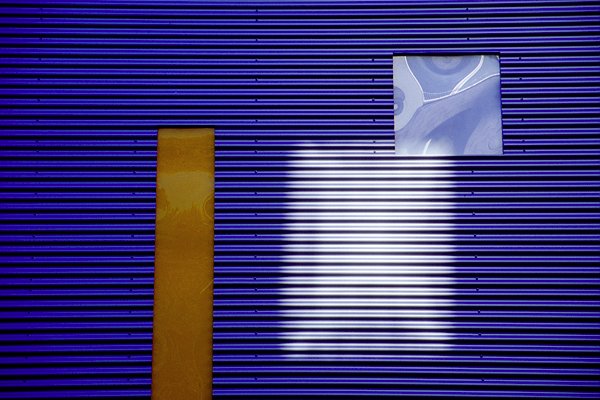
Photograph © Harald Mante. An example of a Lichtkissen.
 
Harald Mante's photographs are detailed views of the man-made environment that are characterized by color, contrasts, shapes and patterns, which all appeals to me very much. The photograph above is part of a theme entitled "Lichtkissen", which literally translates as "cushions of light." Especially if you live in a city and travel through life consciously, you will discover many such light reflections and projections that decorate walls and the ground on sunny days. Lichtkissen are a wonderful example for the discovery of ephemeral beauty in man-made environments.
I should also point out that Harald Mante taught photography at the University of Applied Sciences and Art in Dortmund and also wrote many books on composition and color design in photography. 

I hope you enjoy and wish you a nice weekend!

Florian.

2012/06/09 by Unknown
Categories: , | Leave a comment