October 2014 print: Autumn browns with chamois

Photo & Video Sharing by SmugMug

I am again late to present my monthly print, but the photograph shown here has not only been printed, but also taken in October. We were on a long hike to the Gamsjoch, a rocky summit in the Karwendel, when a herd of almost 70 chamois crossed our path and grazed along the valley slopes. Those of you who understand German realize that the summit's name is most fitting: Gamsjoch translates as "chamois saddle". Our children complained the disorderly distribution of the animals, which made counting difficult. After many counts and deliberations, we agreed on the number 69. The 16 animals in the October 2014 print were part of this huge chamois flock that, I believe, consisted of female and young animals (we could even watch some of them still suckling). Further along during the hike, we kept seeing more and more chamois and even a few ibex and a snow grouse (ptarmigan); but no fellow hiker. What an exceptional day!
Although the colors of this photographs are not flashy and bright, they are nevertheless typically autumnal. I really like the different shades of brown and yellow of the grass, with a slight hint of red, that the chamois complete with they dark brownish winter fur.
Also have a look at my earlier prints or suggest a photograph to be printed!

2014/11/07 by Unknown
Categories: | Leave a comment

My photo treasures: Diane Varner

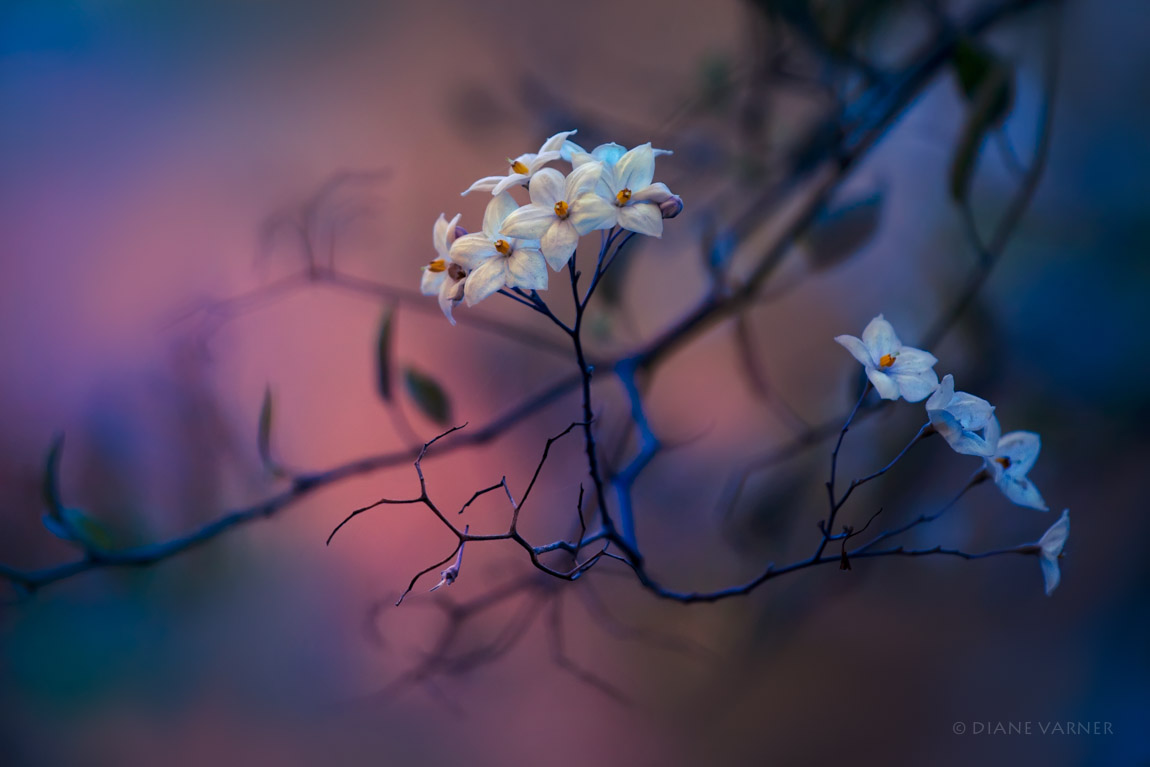
Photograph © Diane Varner. Sweet Dawn (flowers of potato vine, Solanum jasminoides).

The photography of Diane Varner did not catch my eye and interest immediately, but rather grew on me slowly. I was attracted by the subjects that Diane Varner discovers on her daily walks: intimate details of trees, plants and flowers, such as the one above, sea-, water- and landscapes, or even birds. What took me longer to fully realize and appreciate is the unique character of her photographs.

For Diane Varner, post-processing is just as important as the actual photo searching and taking process. In most cases, the original content of the composition is not altered, but countless hours are spent exploring the photographs in the digital darkroom. She enjoys experimenting with the computer and to me, her photographs reveal a great effort for the choice and adjustment of the colors and overall appearance. If you are interested, Diane Varner shares some of her digital developing techniques in great detail in post-processing tutorials that feature before and after examples and also include PSD files to explore.

To me, the most distinguishing characteristic of Diane Varner's photographs are the colors, which always create an airy, mystical, and also slightly surreal atmosphere. This unique mood is often emphasized by the contrast between the sharp main subject and the out-of-focus elements in the background. What I appreciate the most is the attention to the small details of beauty that are easily overlooked, but that enlighten our days if we are just willing to look carefully and consciously. None of her photographs feature iconic landmarks!

Diane Varner explores the beauty nearby her home on daily walks with her dog and also shares her creations in an award-winning blog with that name (for example, her blog is in the top 10 on coolphotoblogs!). It is inspiring to read about her growing awareness of the small gems in her environment and how, by her daily explorations, "the mundane had become magical and I wanted to record it and share my excitement of what I had found". To learn more about her photography and to enjoy her images, head over to the daily walks website, visit her galleries, and maybe read some of the interviews that she has given (listed on her "about page"). The photograph above is one that I think is particularly representative for Diane Varner's photography. It is also a photograph that does not only appeal to me, but also to the masses: it has been awarded in the International Garden Photographer of the year 2012 competition with the third place.

2014/11/01 by Unknown
Categories: | Leave a comment

Leafcolors 4: "Cherry pox"

Photo & Video Sharing by SmugMug

Pay attention to the tiny red dots on this yellow cherry leaf, as if it had "cherry pox". Although the signs of pathogen attack and decay are only small, the beauty lies, as it is often the case, in the detail. Over the years, I have looked at many high-resolution leafscans that often reveal details that I hardly ever notice when I just rustle through fallen autumn foliage. Pathogens that cause lesions such as the dark spots on this cherry leaf often alter the tissue around the point of attack. The visual testimony of this host-pathogen interaction is often a distinctly colored halo around lesions. Whatever the cause, you may just enjoy the tiny red spots!
Also, have a look at the other images in the leafcolor gallery, all of which are not photographs, but scans.

2014/10/31 by Unknown
Categories: , , | Leave a comment

Watercolors 11: Tuolumne River watercolors

Photo & Video Sharing by SmugMug

Today's watercolor compositon brings me back to California, more specifically to Yosemite National Park. During our summer holiday of last year, Tuolumne meadows was our first stop after leaving San Francisco. After a morning hike to Lembert Dome, we made a lengthy pause at Tuolumne River, where the children played in the water and I used the time to photograph. I was particularly intrigued by the watercolor swirls and patterns on the surface of the water gushing around rocks. For me, the photograph above captures the essence of that impression and I hope some of you like it.
If you want, have a look at the watercolor photographs shown in earlier blog posts or at the watercolor gallery.

2014/10/25 by Unknown
Categories: , , , | Leave a comment

Tilt-shift: A new MILTS camera

Photo & Video Sharing by SmugMug The building called Forum Chriesbach that has been shown in several nearby photographs already. In this example, the lens was shifted upwards for perspective control. The photograph belongs to the reflections gallery: Almost the entire right half is the mirror image of the left half. The reflective surface belonged to only one of the building's glass panes that was just a few centimeters from the lens away, and yet, focus was on infinity.

I have a new, mirrorless, interchangeable lens, tilt-shift (MILTS) camera. My MILTS camera allows any lens with a Canon EF mount to be shifted by 15 mm and tilted by 10° in any direction (tilt and shift movements are perpendicular to each other). In my case, the camera's specifications are identical to a Sony A7r, but it could just as well be any Sony E mount camera; thanks to the Canon EF - Sony E mount tilt-shift adapter from Mirex (it is not advertised on their website - you have to contact the company by e-mail).

The Sony E mount tilt-shift adapter's specifications are virtually identical to the version for micro four thirds (M4/3) cameras. The tripod mount is interchangeable between the two adapters and the tilt-shift mechanisms are the same; only the lever to rotate the adapter is differently designed. I find it more convenient on the Sony model. First, I had planned to use my micro four thirds tilt-shift adapter with a cheap M4/3 - Sony E mount adapter, but unfortunately the two adapters that I have tried were not fitting properly. Albeit not fitting well at all, the set-up allowed to test my manual lenses and their tilt-shift capabilities on a full frame body. To my surprise, all the nice, old lenses that I am using allow both, tilt and shift movements, although not the full amount. As expected, the corners of the frame get black when the lens is shifted maximally. The exact degree of tilt and shift (without vignetting) is specific for each lens (due to different image circles) and also depends on the sensor size of the camera (it would be much less of an issue with a smaller sensor).

All in all, I am just as satisfied with the Sony version of the tilt-shift adapter as with my micro four thirds model. If at all, handling is even easier on the Sony body, because it is slightly larger than my Lumix GH1 and because of focus peeking: It is quite cool to see colors indicating the areas in focus move across the frame as you tilt the lens. The adapter is, in my opinion, extremely well built and has quickly become an integral component of my Sony A7r body. Since I am using almost exclusively old manual lenses (Leica R, Olympus Zuiko, Voigtländer) that are permanently adapted to a Canon EF mount (with a Leitax replacement mount), I hardly ever take the adapter off the camera. If you want to learn more about the Canon EF - Sony E mount tilt-shift adapter, head over to the excellent review at "on landscape" or post a question as a comment to this posting.


P.S. I have bought the tilt-shift adapter that is described here as a regular customer from Mirex. I am not associated with Mirex and I do not receive any form of compensation for writing this text. 

2014/10/19 by Unknown
Categories: , , , , | Leave a comment